

You know that moment? You finish dragging all your files onto that new external hard drive. The little progress bar fills up. You feel… responsible. Adult. Like you’ve finally got your digital life together. You unplug the drive, hold it in your hand, and then you stare at it.
“Where do I put this thing?”
If you’re anything like me, here’s what happens next. You walk around your house with it. You open a kitchen drawer. Too full of spoons. You go to your office. The shelf is dusty. You think about the basement and get a chill. Literally. It’s damp down there.
Finally, you sigh, shove it into the drawer of your bedside table, right next to a tangled charger and that book you keep meaning to finish. You close the drawer. Problem solved.
Except you and I both know it’s not. That little drive is now your only copy of your kid’s toddler photos, your mortgage paperwork, the video from your wedding. And it’s sitting next to a leaking battery from an old remote. It’s madness.
We do it because no one ever tells us the real way to do this. They give us tech specs—humidity percentages, temperature ranges—but they don’t tell us what it feels like to actually keep something safe for ten years.
Let me tell you what I learned. Not from a manual. From messing up.
My Personal Disaster (The Short Version)
A few years back, I was you. I had a drive. I put it in a really nice cardboard box and stored it on a shelf in my finished basement. “Finished,” I thought. “It’s fine.”
Then my water heater gave up the ghost. Not a flood. Just a slow, weeping leak over a weekend we were away. The humidity spiked. I came home to a basement that smelled like a wet dog. The box was damp. The drive was… fine, at first. But a month later, when I needed a file? It made this awful clicking sound. A death rattle. The data recovery guy looked at me with pity. “Corrosion,” he said. “How was it stored?”
I wanted to throw up. That was the lesson I paid for. So let me save you the tuition.
The “Good Enough” Home Storage Method (If You’re Stubborn)
You’re gonna keep it at home. I get it. I did. If you’re determined, here’s my bare-minimum, swear-on-my-life advice.
- First, kill the static. Don’t just drop the drive into a plastic bin. Wrap it in a cotton tea towel first. Seriously. The ones you never use. It absorbs any tiny moisture shifts and cushions it.
- Second, the container matters. Get a sealed plastic bin. Not a box with a lid. A bin with a gasket seal. The kind meant for Christmas ornaments. This is your drive’s spacesuit against your home’s environment.
- Third, location is everything. Forget the basement. Forget the attic. Your garage is a torture chamber of temperature swings. The best place in a normal house?
The closet of a hallway or an interior room. Not an outside wall. The more “buried” in the center of your house, the more stable the temperature. Put the sealed bin on a shelf, not on the floor. Floor = spills, leaks, puppy accidents. - Fourth, the sticky note. Write the date and “BACKUP – LAST RESORT” on a bright sticky note. Put it on the bin. This is so you, or your partner during a cleaning frenzy, doesn’t look at it and think “old cables” and donate it.
That’s it. That’s the “good enough” method. It works… until your home has a problem. And homes always have problems.
The “Sleep Like a Baby” Method (What I Do Now)
After my great basement flood, I got paranoid. My house is for living. It’s chaotic. It has leaks, and heat waves, and times when the power goes out and the sump pump stops. I needed a place that had one job: keep things safe.
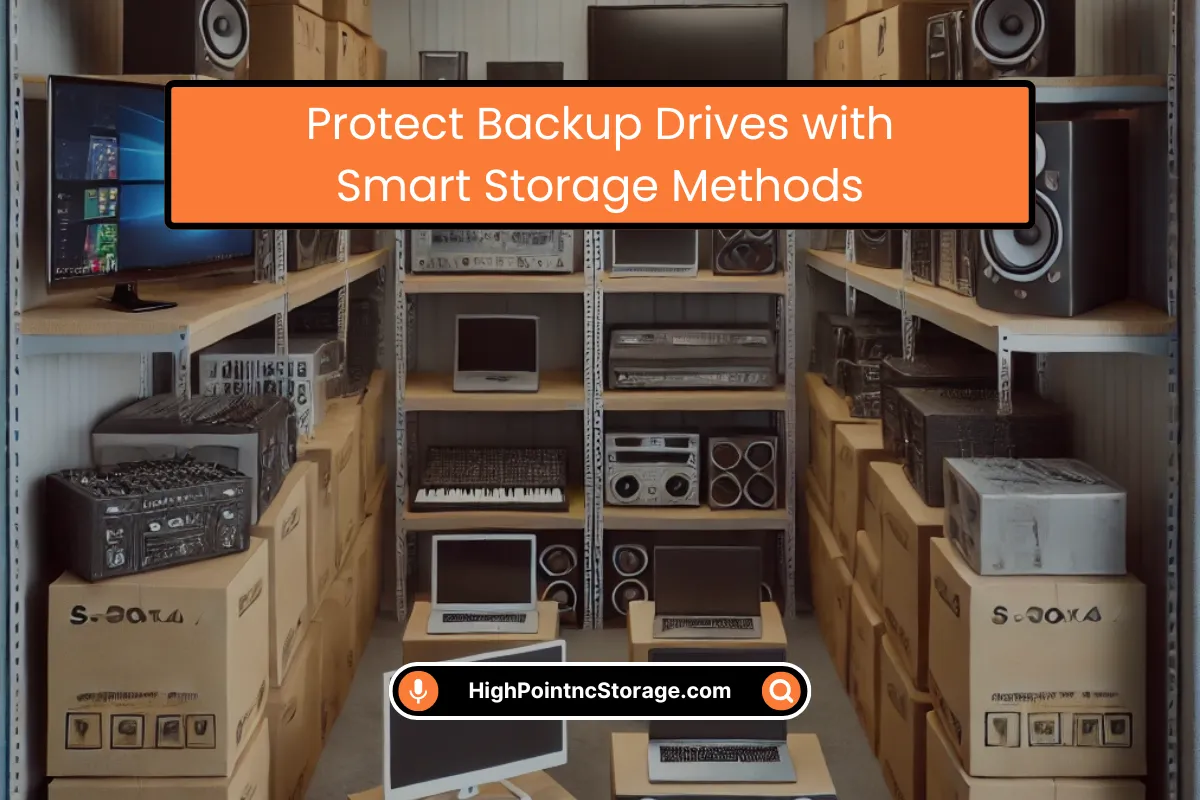
That’s when I broke down and got a small storage unit. And listen—I’m not a fancy person. I’m not storing a sports car. I got the smallest one they had, a 5×5. It’s the size of a phone booth.
But here’s the magic word: climate-controlled
That means it’s not a metal shed that turns into an oven in summer and a freezer in winter. It’s a clean, dry room that stays at a steady, boring, perfect 65-75 degrees year-round. No humidity. No dust. No risk of a pipe bursting above it.
I went down to the local place, checked it out. The guy showed me around. It was… just a calm, quiet, clean hallway of locked doors. It felt like a library vault. I signed up.
Now, my system is stupid simple:
- I do my backup at home on the first of every month. It’s on my calendar.
- I put the drive in its sealed bin.
- Next time I’m running errands, I swing by the storage place. I use my code, walk down the hall, unlock my unit, and swap the old drive for the new one.
- I take the old one home, wipe it, and it’s ready for next month.
The whole trip takes 10 minutes. The cost? Less than I spend on coffee in a week.
The peace of mind? It’s everything. My house could have a disaster tomorrow. Fire, flood, theft. And yeah, that would be awful. But in the back of my mind, I’d know: the photos, the documents, the stuff that can’t be replaced… it’s all safe. It’s waiting for me. It’s my actual lifeline.
That’s the real goal, isn’t it? Not just to have a backup. But to know, deep in your gut, that it’s truly safe.
So look at that drive in your drawer. Give it the home it deserves. Your future self will thank you. Mine does. Every single day.










0 Comments